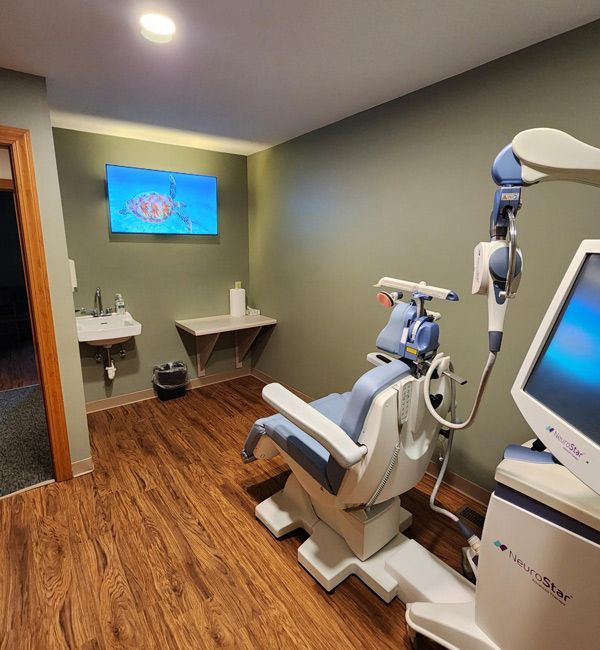
Precise Brain Mapping
Initial mapping identifies your motor threshold and coil position to customize magnetic pulse intensity and location for optimal treatment.
5136 East Stop 11 Rd, Suite 30
Indianapolis, Indiana, 46237
Hours
Mon - Fri: 8am - 5pm
Sat - Sun: Closed
Your initial Transcranial Magnetic Stimulation (TMS) session is a structured, non-invasive process designed to establish personalized settings and safely deliver focused brain stimulation for depression relief.
Initial mapping identifies your motor threshold and coil position to customize magnetic pulse intensity and location for optimal treatment.
You remain fully alert and comfortable in a chair with no anesthesia, sedation, or downtime required during or after the session.
The initial mapping and treatment session lasts about 60 minutes, while subsequent routine sessions take around 20 to 40 minutes.
Patients typically drive themselves home and return to regular daily activities, work, or school immediately following appointments.
If you are considering transcranial magnetic stimulation (TMS) for depression, the treatment itself may still feel unfamiliar. Questions about the first appointment are common: What is mapping? Will TMS hurt? How long will you be there? Can you drive afterward? And what happens once the first session is finished?
Accentus Mental Health provides TMS therapy for patients in Indianapolis, Avon, and surrounding Central Indiana communities. TMS is a noninvasive treatment that uses focused magnetic pulses to stimulate areas of the brain involved in mood regulation. It does not require surgery or anesthesia.
Your exact treatment plan depends on your diagnosis, health history, medications, insurance requirements, and the protocol your clinician recommends. Still, knowing the usual steps can make the first visit feel much more predictable.
The exact process varies by patient and treatment protocol, but these are the main stages to expect.
Your care team reviews your history and treatment needs.
The treatment position and stimulation reference are established.
Magnetic pulses are delivered while you remain awake.
You can generally return to your normal activities after outpatient TMS.
Your first TMS treatment session usually comes after a clinical evaluation. The goal is to understand your symptoms, previous treatments, medical history, current medications, and any factors that could affect TMS safety or eligibility.
If you are still asking whether TMS may be right for you, Accentus explains common candidacy considerations in its guide to qualifying for TMS therapy in Indianapolis. Insurance plans may also have requirements, particularly when TMS is used for treatment-resistant major depressive disorder.
Before treatment, your care team may ask about implanted or metallic devices, seizure history, prior brain injury, other medical conditions, and medications or supplements you take. Mayo Clinic's TMS patient guide also recommends sharing this information before treatment begins.
This screening matters because TMS is individualized. The first treatment visit is not simply a matter of sitting in a chair and turning on a machine. The care team first establishes treatment settings for you.
During mapping, your clinician identifies the appropriate treatment location and establishes an individualized stimulation reference. A small hand or finger movement may help determine motor threshold.
Mapping is the process used to determine where the TMS coil should be positioned and how much stimulation should be delivered. This is one reason the first treatment appointment can take longer than later sessions.
During mapping, you typically sit awake in a treatment chair while the clinician positions the coil near your scalp. The coil sends brief magnetic pulses. The clinician may move the coil and adjust the intensity while watching for a small movement in a hand or finger.
That response helps identify your motor threshold, an individualized reference point used to help set treatment intensity. Mapping also helps the clinician establish the treatment location for your prescribed protocol.
Mayo Clinic notes that coil placement and stimulation dose are commonly established during the first treatment visit, then those measurements guide later sessions. Settings may be reassessed when clinically appropriate.
TMS is performed while you are awake. It does not require general anesthesia, an IV, or sedation.
The device produces repeated clicking sounds, and hearing protection may be provided during treatment.
Magnetic pulses can create a tapping sensation on the scalp. Mild scalp discomfort or headache can occur.
Once mapping and treatment settings are established, the treatment portion can begin. The exact sequence varies by protocol and device, but several parts of the experience are common.
TMS is performed while you are awake. You will be seated rather than placed under anesthesia or sedation. The care team positions the coil near the treatment area on your scalp. You may also be given hearing protection because the device produces repeated clicking sounds.
Accentus uses an Apollo TMS system and describes TMS as an outpatient procedure, so there is no hospital admission or post-anesthesia recovery period.
When stimulation begins, you will hear clicking and may feel a tapping sensation on your scalp. Pulses are delivered in repeated patterns, with periods of stimulation and pauses depending on the treatment protocol.
Mild scalp discomfort or headache can occur, especially early in treatment. If something feels too uncomfortable, tell the treatment team. Communication helps the team understand how you are tolerating treatment.
You stay awake throughout the session. TMS does not require an IV or a sedating medication. The National Institute of Mental Health describes repetitive TMS as a noninvasive brain stimulation therapy that uses an electromagnet to deliver repeated magnetic pulses. For depression, it is commonly considered when previous treatments have not provided enough relief.
Plan for the first treatment visit to take longer than a routine session because mapping and motor-threshold testing need to be completed first. Mayo Clinic notes that a first TMS appointment commonly lasts about an hour, although actual timing depends on the clinic, device, protocol, and individual patient.
Accentus notes that routine TMS sessions may last roughly 20 to 40 minutes. Once your initial measurements are established, later appointments can focus more directly on the prescribed treatment.
If you are balancing treatment with work, school, caregiving, or a commute across Indianapolis, ask about scheduling before your course begins. TMS for depression typically involves repeated visits over several weeks, so a realistic appointment time can make consistency easier.
Standard outpatient TMS usually does not involve anesthesia recovery or required downtime. Mayo Clinic notes that people can generally work and drive between treatments. Some patients prefer to arrange a ride after the first session simply to learn how they personally feel afterward.
Follow the instructions your clinician gives you. Let the care team know about headaches, scalp discomfort, mood changes, sleep changes, or other symptoms that occur during the treatment course.
After the first visit, the routine becomes more familiar. The care team can use the positioning and treatment parameters established during mapping, with reassessment when needed.
Later sessions generally involve getting seated, positioning the coil, confirming treatment settings, completing the stimulation protocol, and leaving the office afterward. Because full mapping is not typically repeated at every visit, these sessions are usually more straightforward.
Consistency matters because TMS for depression is delivered as a treatment course, not a one-time procedure. Accentus discusses the time commitment, potential benefits, side effects, and other practical considerations in its
TMS therapy pros and cons guide.
You do not need to prepare for TMS the way you would for surgery, but a little planning can make the visit easier.
Bring an up-to-date medication and supplement list, plus any information your clinician requested about previous depression treatments. Tell the care team about relevant changes in your health, medications, sleep, substance use, or seizure history. If you have questions about implants or metal in or around your head, raise them before treatment.
It also helps to write down practical questions. You may want to ask how long your specific sessions are expected to last, how frequently you will attend, what side effects should prompt a call, whether your motor threshold may be rechecked, and how progress will be measured.
Do not change prescription medications or other parts of your treatment plan on your own because you are starting TMS. Discuss changes with the clinician managing your care.
The first TMS treatment can feel unfamiliar, but the process is structured. Your care team reviews your history, establishes individualized settings through mapping and motor-threshold testing, positions the coil for treatment, and guides you through the stimulation session while you remain awake.
For patients around Indianapolis, South Indianapolis, East Indianapolis, Avon, Greenwood, Plainfield, and nearby Central Indiana communities, understanding the first visit can make it easier to decide whether you are ready to take the next step.
If depression symptoms have continued despite medication, psychotherapy, or other treatment, learn more about
TMS therapy at Accentus Mental Health or
schedule a consultation to discuss whether TMS may be appropriate for you.
If depression symptoms have continued despite medication or psychotherapy, learn more about TMS therapy at Accentus Mental Health or schedule a consultation to discuss whether TMS may be appropriate for you.
Experiencing depression or a neurological disorder? Remember, you are not alone. Get help today!







Accentus Mental Health cares greatly about your mental health. If you reside in or near Indianapolis, Greenwood, Franklin, Whiteland, Bargersville, Mooresville, Martinsville, Monrovia, Plainfield, Avon, or the surrounding area, we will help you live the life you were meant to live. Our services are covered by most insurance plans, are FDA-cleared, non-invasive, and involve no drug side effects.