Targeted Circuitry
TMS uses targeted magnetic pulses to modulate specific, overactive brain circuits related to error detection, habits, and threat responses in OCD.
5136 East Stop 11 Rd, Suite 30
Indianapolis, Indiana, 46237
Hours
Mon - Fri: 8am - 5pm
Sat - Sun: Closed
When standard medication and Exposure and Response Prevention (ERP) therapy have not provided sufficient relief, non-invasive Transcranial Magnetic Stimulation (TMS) offers an FDA-cleared, add-on option to help target OCD brain circuitry.
TMS uses targeted magnetic pulses to modulate specific, overactive brain circuits related to error detection, habits, and threat responses in OCD.
FDA-cleared for adults with treatment-resistant OCD, TMS works alongside existing therapy and medication regimens without requiring surgery or anesthesia.
A comprehensive clinical review evaluates past ERP courses, medication history, symptom severity, and safety considerations to determine eligibility.
Coverage depends on specific plan policies and prior authorization requirements. Benefits and treatment protocols are verified prior to starting care.
Obsessive-compulsive disorder can take up far more of the day than other people realize. Intrusive thoughts may create intense distress, while checking, washing, counting, reassurance seeking, mental rituals, or avoidance can become difficult to control. For many people with OCD, evidence-based treatment can make a meaningful difference. Exposure and response prevention, commonly called ERP, is a first-line psychological treatment for OCD. Medication is also commonly used. But some people complete therapy, try medication, or use both and still have symptoms that interfere with work, school, relationships, sleep, or daily routines.
When that happens, it may be time to discuss additional options with a mental health professional. For some adults with persistent OCD symptoms, transcranial magnetic stimulation, or TMS, may be one option to consider.
A treatment can help without providing the level of relief a person needs. Someone may notice fewer compulsions but still lose hours each day to rituals. Another person may improve on medication but continue to struggle with intrusive thoughts or avoidance.
The International OCD Foundation treatment guide identifies ERP and medication as first-line treatments for OCD. ERP is a specialized form of cognitive behavioral therapy that gradually helps a person face triggers while resisting the compulsive response. Medication can also reduce OCD symptoms, and some people benefit most from a combination of medication and ERP.
Before deciding that a treatment has not worked, a clinician may look at whether the diagnosis is accurate, whether ERP was delivered in an OCD-specific way, whether medication was taken at an appropriate dose and for an adequate length of time, and whether other conditions are affecting symptoms.
If OCD remains disruptive after appropriate first-line treatment, a psychiatric evaluation can help identify whether medication adjustments, more specialized ERP, a higher level of therapy, or a neuromodulation option such as TMS should be considered.
Confirm the diagnosis and review current symptoms, medical history, and treatment goals.
Consider prior ERP, medication trials, response to treatment, and other contributing factors.
If symptoms persist, the clinician may discuss specialized therapy, medication changes, or neuromodulation.
The selected approach can be coordinated with ongoing therapy, ERP, and medication when appropriate.
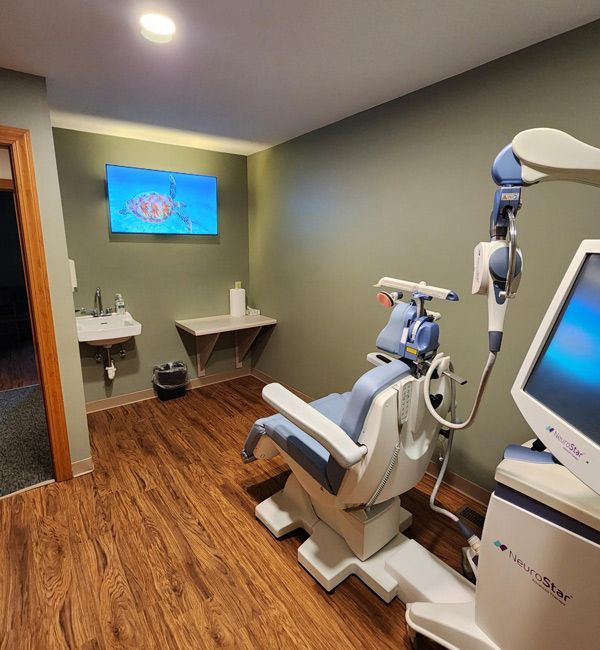
TMS is a non-invasive treatment that uses magnetic pulses to influence activity in targeted brain networks. It does not involve surgery or anesthesia and is typically delivered in an outpatient setting.
In 2018, the U.S. Food and Drug Administration permitted marketing of the first deep TMS system for OCD. Since then, additional devices and protocols have received FDA clearance for adjunctive treatment of OCD. The FDA's original decision was based on a randomized study in adults whose OCD symptoms had not responded adequately to traditional treatment.
The International OCD Foundation's TMS guidance describes TMS as an option for people who have already tried first-line treatment and are still struggling. It also emphasizes that TMS is generally used as an add-on to established OCD care rather than a replacement for ERP or medication.
TMS is not the automatic next step for every person with OCD. The specific device, coil, brain target, and treatment protocol matter. A qualified clinician should review a patient's diagnosis, treatment history, medical history, medications, and goals before recommending TMS.
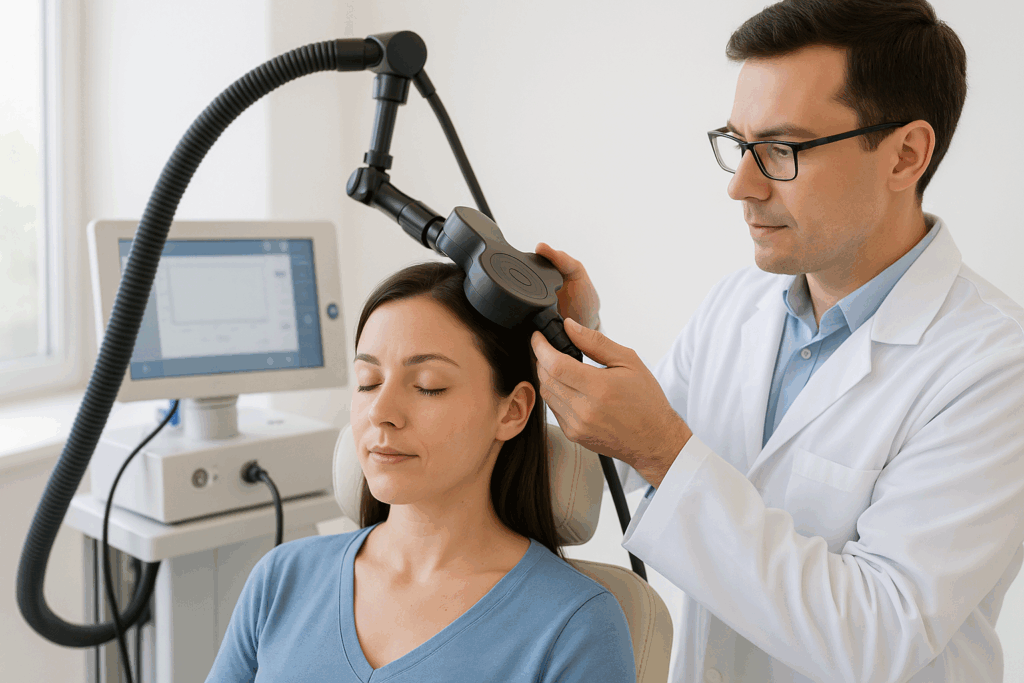
OCD involves patterns of activity across brain circuits related to error detection, habits, threat, and behavioral control. TMS uses a magnetic field generated by a treatment coil placed against the scalp. The magnetic pulses can influence activity in targeted brain networks.
For OCD, FDA-cleared approaches use specific stimulation protocols and brain targets. Some protocols also involve a brief, individualized symptom provocation immediately before stimulation. Patients should ask which device and OCD protocol a clinic uses and whether that protocol is FDA-cleared for OCD.
You remain awake and seated during treatment. TMS is delivered in an outpatient setting without anesthesia.
The device produces repeated clicking sounds, and many people describe a tapping sensation on the scalp.
There is generally no recovery period afterward, although temporary scalp discomfort or headache can occur.
During treatment, the patient remains awake and seated. The device produces repeated clicking sounds, and many people describe a tapping sensation on the scalp. No anesthesia is required, and there is generally no recovery period afterward.
Temporary discomfort at the treatment site or headache are among the more common side effects. A clinician should also review less common risks, implanted devices, and other safety considerations before treatment begins.
TMS is delivered as a series of sessions rather than a single appointment. The exact number of sessions, session length, and schedule depend on the device and protocol being used.
Patients may want to ask how often they will need to come to the office, how long appointments usually take, and how treatment can fit around work or family responsibilities.
A consultation is the best way to determine whether TMS should be part of an individual treatment plan. In general, a clinician may explore TMS when an adult has a confirmed OCD diagnosis, continues to have meaningful symptoms, and has already tried evidence-based first-line treatment.
A treatment review may include questions such as:

It can be tempting to compare OCD treatments as if one has to replace the others. In practice, they often serve different purposes.
ERP helps people change their response to obsessions and break the cycle between fear and compulsive behavior. Medication can reduce symptom intensity and make OCD more manageable for some people. TMS targets brain circuitry through non-invasive stimulation.
For someone who has made partial progress with ERP or medication, the question may be whether adding another evidence-based option could help them make further progress. That is why OCD specialists often view TMS as an adjunctive treatment for people who continue to struggle after first-line care.
A coordinated plan may include ongoing medication management, psychotherapy, ERP with an OCD specialist, or other services depending on the person's needs.
A consultation should give you enough information to make an informed decision. Useful questions include:
Insurance coverage varies. Some plans may cover certain protocols when medical-necessity requirements are met, while others may not. Benefits should be verified before treatment begins.
Living with persistent OCD can be exhausting, especially when you have already put significant effort into treatment. Continued symptoms may mean your treatment plan needs another level of evaluation.
Accentus Mental Health provides psychiatric services and TMS therapy for patients in the Indianapolis area, including people traveling from Greenwood, Franklin, Whiteland, Bargersville, Mooresville, Martinsville, Monrovia, Plainfield, Avon, and nearby communities. The practice also offers medication management and psychotherapy, allowing patients to discuss TMS within the context of their broader mental health treatment.
If ERP, medication, or a combination of treatments has not provided enough relief from OCD, a consultation can help clarify whether TMS is appropriate and what other options may still be worth considering.
Learn more about Accentus Mental Health's TMS for OCD services or schedule a consultation to discuss your treatment history and next steps.
Experiencing depression or a neurological disorder? Remember, you are not alone. Get help today!





Accentus Mental Health cares greatly about your mental health. If you reside in or near Indianapolis, Greenwood, Franklin, Whiteland, Bargersville, Mooresville, Martinsville, Monrovia, Plainfield, Avon, or the surrounding area, we will help you live the life you were meant to live. Our services are covered by most insurance plans, are FDA-cleared, non-invasive, and involve no drug side effects.